Holidays & Rituals · 제사 · 11 min read
제사: Korean ancestral rites, and why so many families are simplifying them
What 제사 and 차례 are, why the table has so many rules (and which ones Korea's Confucian headquarters says you can drop), how the bowing works, who ends up frying all that jeon, and what to do if you're invited to one.
It’s the day before Chuseok, and you’ve just stepped into your partner’s family’s apartment. The smell hits you first: sesame oil and frying batter. The living room floor is covered in newspaper, and two or three women are kneeling around an electric griddle, turning out golden pancakes (전, jeon) at a speed that suggests years of practice. In the corner stands a folding wooden table, and on a shelf, a framed photo of a grandfather you never met.
Tomorrow morning, that table will be covered in food arranged by rules someone in this room will argue about. Everyone will bow to the photo, then eat the food. And at some point, someone will kindly ask whether you’d like to bow too.
Welcome to 제사.
The short version: 제사 (je-sa) is a memorial rite for ancestors, traditionally held at night on the anniversary of a death. 차례 (cha-rye) is the shorter holiday version, held on the morning of Seollal and Chuseok. Food is laid out, the family bows, and everyone eats it together. The table rules look strict, but in 2022 Korea’s Confucian headquarters said many of them aren’t actually required, and that nobody has to fry jeon. More and more families are simplifying the rites or dropping them altogether. If you’re invited: watch, offer to help, and bow only if you’re comfortable. Nobody will force a guest.
제사 vs. 차례: two rites, one very busy kitchen
제사 (je-sa), the death-anniversary rite. Strictly speaking, 제사 is the general word for any rite of offering, and the anniversary rite is called 기제사 (gi-je-sa). In everyday speech, though, “we have 제사” means the anniversary of a grandparent’s or parent’s death. According to the Encyclopedia of Korean Culture, it was customarily held at the very start of the day of death, around 11:30 p.m. to midnight. More recently, many families hold it in the evening instead.
차례 (cha-rye), the holiday rite. Held on the morning of Seollal (Lunar New Year) and Chuseok (the autumn harvest holiday). It’s simpler in structure, but because it happens on the two biggest holidays, with the whole extended family present, it’s the one most Koreans picture when they hear “ancestral rites.”
Traditionally, families honored up to four generations of ancestors this way. Do the math and you can see why some households seemed to hold a rite every few weeks.
Say / Mean: 이번 주말에 제사가 있어서… (i-beon ju-ma-re je-sa-ga i-sseo-seo) literally means “We have a jesa this weekend, so…”. What it means: “I’m unavailable, I’ll be at my parents’ place from Friday night, and don’t ask why I look exhausted on Monday.” Among Korean coworkers, it ends the conversation instantly.
The table: a seating chart for food
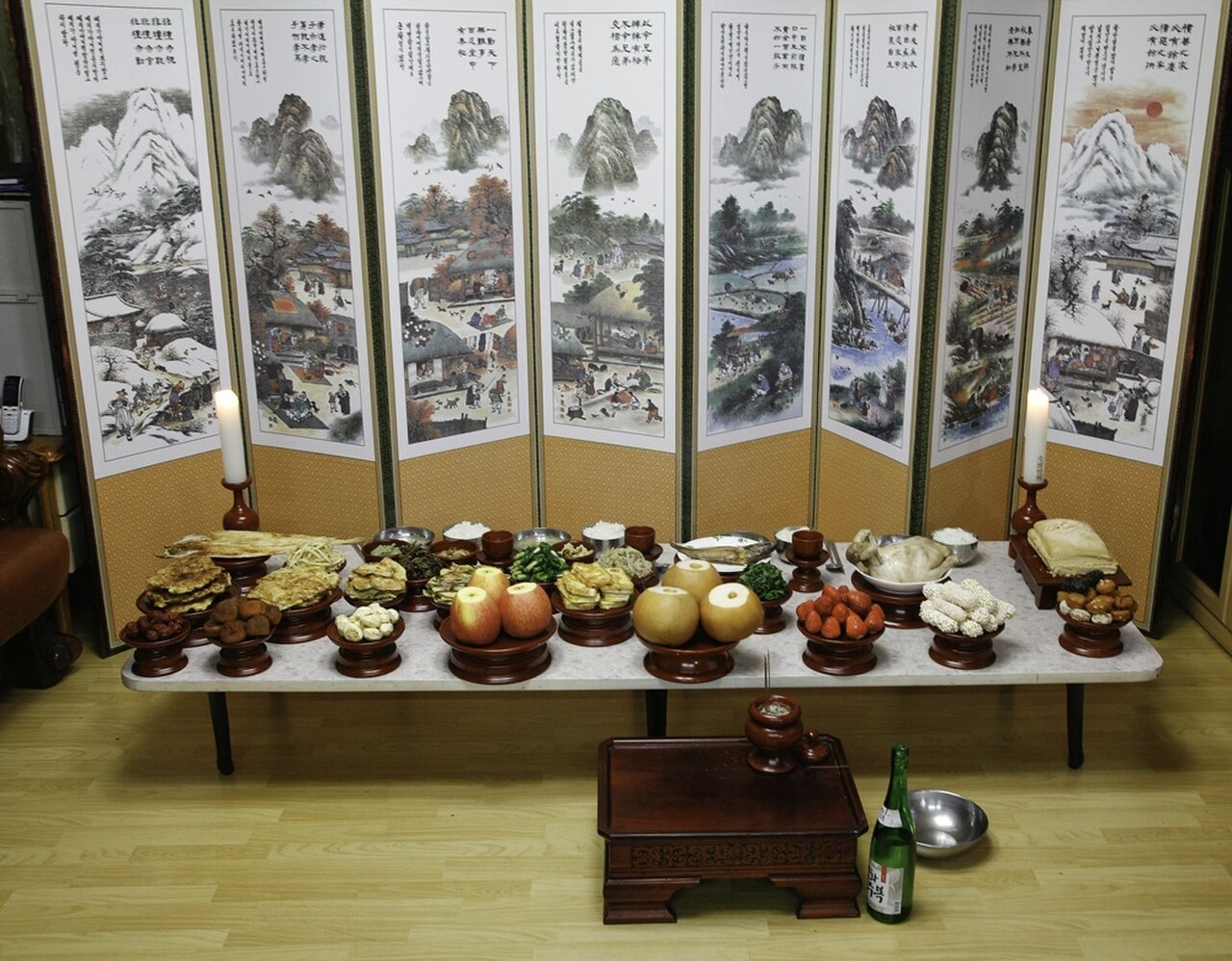
The heart of the rite is the table of offerings, the 제사상 or 차례상, and it comes with rules, many memorized as four-character rhymes:
| Rule | What it says | In plain English |
|---|---|---|
| 홍동백서 (hong-dong-baek-seo) | 紅東白西 | Red fruit on the east, white fruit on the west |
| 조율이시 (jo-yul-i-si) | 棗栗梨枾 | Jujubes, chestnuts, pears, persimmons, in that order |
| 어동육서 (eo-dong-yuk-seo) | 魚東肉西 | Fish on the east, meat on the west |
| 좌포우혜 (jwa-po-u-hye) | 左脯右醯 | Dried meat or fish on the left, sweet rice drink (식혜) on the right |
| 고서비동 (go-seo-bi-dong) | 考西妣東 | Grandfather’s place on the west, grandmother’s on the east |
“East” here doesn’t mean actual compass east, by the way. The table is imagined as facing south, so east is on the right as you face it. This has never once stopped two uncles from pointing in opposite directions.
Many families also keep a list of things that never go on the table, often including peaches, red chili powder and garlic. Ask five families and you’ll get five different lists, each defended as the One True Way.
The day the jeon died
Then, on September 5, 2022, something remarkable happened. The ritual committee of Sungkyunkwan, the historic Confucian academy that acts as the headquarters of Korean Confucianism, held a press conference and presented a “standard” holiday table. Here’s what they said, as reported by the Chosun Ilbo:
- Six kinds of food is the basic table: songpyeon (rice cakes), three-color namul (seasoned vegetables), a grilled dish, kimchi, fruit and alcohol. Laid out, that came to nine dishes. Meat, fish and rice cakes could be added if the family wanted.
- Jeon is not required. The committee cited a Joseon-era scholar, Kim Jang-saeng, who wrote that offering oily foods at a rite was not proper. Fried and pan-fried foods, they said, don’t have to go on the table at all.
- 홍동백서 and 조율이시 don’t appear in the old ritual texts. Where to put things, how many fruits, whether to visit the grave first: the family can decide together.
Now picture the reaction. For decades, the night before every holiday had meant hours on the floor flipping battered fish and zucchini into towering stacks. And here was the highest authority in Korean Confucianism announcing at a press conference that the ancestors never asked for any of it. Across the country, a generation of daughters-in-law received this news roughly the way people receive a winning lottery ticket: disbelief, a careful second reading, and then a screenshot sent to the family group chat with no comment, because none was needed.
The committee chair was frank about why: every holiday, he said, Confucianism got blamed for “holiday syndrome,” gender discrimination and even post-holiday divorces, and he hoped the standard would ease the costs and the conflicts between men and women and between generations. Then he added, personally, that he’d be fine with putting pizza or chicken on the table too, because a simplified rite is better than descendants giving up rites altogether.
So yes, the pizza debate is real, and it has been officially blessed. The next time your family spends twenty minutes arguing over whether Grandpa, who loved pepperoni, would want a slice next to his chestnuts, you can cite Sungkyunkwan. (Whether this ends the argument or starts one about crust is up to your family.)
The rite itself: what actually happens
Every family varies, but the basic shape, based on the Encyclopedia of Korean Culture and Sungkyunkwan’s 2023 recommendations, looks like this:
- Setting up. The table goes against a wall, with a paper tablet bearing the ancestor’s name (지방, ji-bang) or, increasingly, a photo.
- Inviting the spirit (강신). The person leading the rite, usually the eldest son or grandson (제주), lights the incense and pours alcohol into a small bowl of sand in three pours.
- The first bows. Everyone bows together. Traditionally men bowed twice and women four times; Sungkyunkwan’s modern guidance simply has all participants bow twice.
- Offering drinks. Cups of alcohol are offered, sometimes by several family members in order of seniority. At a 제사, a written prayer (축문) may be read.
- The final bows. In many families, everyone first waits quietly for a moment to let the ancestor “eat.” Then everyone bows twice again, the paper tablet is burned, and the table is cleared.
- Eating together (음복, eum-bok). The family shares the food from the table. This is where you discover why there were nine plates of jeon.
The whole ritual can take as little as fifteen minutes. The cooking that led up to it may have taken two days.
Who does the cooking? The part nobody frames on the wall
Here’s the uncomfortable truth about 제사: in many families, the men bow and the women cook.
The rite is led by the eldest male line. The food was traditionally prepared by the women, often the daughters-in-law, who might spend the whole day before a holiday in someone else’s mother’s kitchen. In a 2016 Korea Transport Institute survey of 9,000 households, the number one worry about Seollal among women (38.4%) was cooking and preparing the ritual table. Men’s top worry? Traffic.
This has a name: 명절증후군 (myeong-jeol jeung-hu-gun), “holiday syndrome,” the stress and family friction that pile up around Seollal and Chuseok: the long drive, the cooking, the in-laws, the questions about marriage and salaries.
And yes, there’s a darker statistic people bring up. In 2013, Yonhap News reported that, based on Statistics Korea’s monthly figures for the previous five years, divorces in the months right after Seollal and Chuseok (February to March, and October to November) ran about 11.5% higher on average than in the month just before. That doesn’t prove jeon causes divorce, but family counselors interviewed at the time said fights over housework and in-law duties often flared up during the holidays. It’s no coincidence that Sungkyunkwan itself named “holiday divorces” when explaining why it simplified the table.
Why it matters so much: 효 and the family that includes the dead
Why keep doing all this? Start with 효 (hyo), filial piety: the duty to honor your parents. In Confucian thinking, that duty doesn’t end when they die. You keep honoring them, and their parents, through rites.
The Encyclopedia of Korean Culture notes that from the Joseon dynasty onward, Korean households based their rites on Zhu Xi’s Family Rituals (주자가례), a Chinese Confucian manual. Over centuries, rites became a marker of a respectable family; skipping them meant failing your ancestors.
There’s something warmer underneath the rules, too. A 제사 is one of the few times the whole family is in one room. Stories come out. Cousins who haven’t spoken in a year end up washing dishes side by side. In a culture built around 우리, “we,” the rite says: the people who came before us are still part of us. That’s what families are trying to keep, even as they cut the menu.
How it’s changing: fewer tables, smaller tables, store-bought tables
The numbers are moving fast:
- Under one in three. In a Hankook Research survey of 1,000 adults (September 4-7, 2026), only 30% said they planned to hold a holiday rite or 제사 this Chuseok, the lowest in the company’s surveys and down from 35% the previous Chuseok and Seollal.
- Down from two-thirds. The JoongAng Ilbo reported that in Rural Development Administration surveys, the share of households holding a Seollal rite fell from 65.9% in 2018 to 39% in 2022.
- Even the Confucians see it. In Sungkyunkwan’s own 2023 survey, only 44.1% of adults said they planned to keep holding rites in the future.
Sungkyunkwan followed up in November 2023 with recommendations for anniversary rites: hold it in the early evening (6 to 8 p.m.) if the family agrees, use a photo instead of a paper tablet, combine parents’ rites if you like, and keep the table to rice, soup, alcohol and three kinds of fruit, plus the foods the person loved, or set it “like a birthday table.” The whole family should cook together. And foreigners can take part too.
Ready-made rites. Supermarkets and online shops now sell complete ritual food sets, delivered to your door. Among people planning a rite in the 2026 Hankook Research survey, 52% said they’d make most of the food themselves, 42% would make some and buy some, and 6% would buy most of it. The ancestors presumably can’t tell Grandma’s jeon from the supermarket’s. Grandma can, and will mention it.
Ask around and you’ll hear plenty of other adaptations: one combined rite a year for all ancestors, a grave visit instead of a home table, a restaurant meal, or the men finally taking over the griddle.
Christian families. Many Korean Protestants don’t hold rites at all, because bowing to ancestors conflicts with their faith. In the same 2026 Hankook Research survey, only 14% of Protestants said they’d hold a rite at Chuseok, compared with 51% of Buddhists and 41% of Catholics. Instead, many Christian families hold a 추도예배 (chu-do-ye-bae), a memorial service at home with hymns, prayers and time to remember the person. The food is still there; it just goes straight to the dinner table.
In mixed families, a common compromise: everyone attends, those who bow bow, and those who don’t stand respectfully or pray silently.
If you’re invited: what a guest should actually do
Being invited means you’re being treated like family, or like someone they hope will become family (see meeting your Korean partner’s parents). Here’s how to handle it well.
Before the day
- Ask what kind of rite it is. Holiday morning or anniversary night? Full table or simplified? Is anyone Christian?
- Dress neatly and modestly. Not funeral black, but nothing loud. Clean socks, because you’ll be on the floor. (Korea will always see your socks.)
- Bring something. A box of fruit is a classic choice (skip the peaches).
In the kitchen
- Offer to help, and mean it. Washing up, carrying plates, flipping jeon if someone trusts you with the griddle. Even if you’re shooed away, the offer is noticed.
Say / Mean: 제가 뭐 도와드릴까요? (je-ga mwo do-wa-deu-ril-kka-yo) means “What can I help with?” Expect 아니야, 괜찮아, 앉아 있어 (“No, it’s fine, just sit”). That’s the polite first refusal. Offer once more; if refused again, sit down and let them feed you. For more on how food and care work in Korean families, see why Koreans ask “have you eaten?”.
During the rite
- Watch first. Stand at the back with the other guests or younger family members, and follow what others do.
- Bowing is optional for you. If you’re invited to bow and you’re comfortable, do the full bow (the same deep bow used at Korean funerals). If not, for religious or any other reasons, politely decline and stand with your head bowed. Families with Christian members are used to this.
- Don’t touch the table. Rearranging the fruit is how you start a family meeting.
- Keep your phone away. No photos of the table or the rite unless the family suggests it.
After the rite
- Eat the food. Sharing the offerings (음복, literally “drinking the blessing”) is part of the ritual. Accepting a plate says you were glad to be there.
- Say thank you. A simple “수고 많으셨어요” (“You worked so hard”) to whoever cooked is worth more than any compliment on the food.
Common mistakes
- Asking “Do you actually believe the ancestors eat this?” Many Koreans who hold rites see it as remembrance, not literal belief. It’s like asking whether birthday candles really grant wishes.
- Sitting while everyone else cooks for six hours. Offer to help. Twice.
- Lecturing about the gender division of labor in the middle of the kitchen. Koreans debate this openly, but on someone else’s holiday morning, a dish towel does more than a speech.
The bottom line
제사 is changing faster than almost any other Korean tradition. Some families still set a full table with every rule observed. Others have a photo, a simple meal and a slice of Grandpa’s favorite pizza. Many have stopped altogether. Even Korea’s Confucian headquarters has said, more or less, that the point was never the jeon. It was the family gathering in one room to remember someone they loved.
If you’re lucky enough to be invited to one, that’s the part to join.