Friends & Social Life · 1차 2차 3차 · 11 min read
1차, 2차, 3차… and 4차 at dawn: how a Korean night out unfolds, round by round
What 1차, 2차 and 3차 mean, what usually happens in each round (barbecue, chicken and beer, karaoke, the orange street tent), how to survive the noraebang, why the night ends with hangover soup, how the long night is fading, and how to go home without starting a negotiation.
It’s 9:40 p.m. The barbecue grill has gone from sizzling to smoking to sad. Someone has eaten the last piece of pork belly while pretending not to. The bill has been paid. Everyone is standing on the pavement outside, zipping jackets, checking phones, doing the slow shuffle of people who are technically leaving.
And then somebody says the two most powerful syllables in the Korean language:
“2차 가자!” (i-cha ga-ja, “Let’s go to round two!”)
Nobody agrees out loud. Nobody goes home either. Ten minutes later you’re in a chicken place with a pitcher of beer, and you begin to realize that in Korea, dinner was never the night out. Dinner was the first chapter.
The short version: a Korean night out is counted in rounds, called 차 (cha). The 1차 is dinner with drinks, often barbecue and soju. The 2차 is a beer pub or chicken-and-beer place. The 3차 might be karaoke (노래방) or a street-tent bar (포장마차). The legendary 4차 is hangover soup at dawn. You move venues between rounds, and a different person often pays each round. Nobody has to stay for all of it, and fewer people do every year. Leave between rounds, say goodbye properly, and you’ve done it right.
What 차 actually means
The Standard Korean Language Dictionary lists 차 (次) as a dependent noun meaning 번 or 차례: “a time” or “a turn.” Stick a number in front and you get the batting order of the evening: 1차 (il-cha), 2차 (i-cha), 3차 (sam-cha).
What makes it Korean is the rule hiding inside the word: each round happens somewhere new. Five hours at one bar is not five rounds; it’s one very long 1차. A new round means walking outside, debating where to go for longer than it takes to get there, and sitting down at a fresh table. The move is the point. It resets the mood, shakes out the people who need to go home, and tells the ones who stay: we’re not done with each other yet.
The work version is in our 회식 guide. This one is about nights out with friends and classmates, where the rounds work the same way but nobody has a corporate card.
The classic route, round by round
Every night is different, but the “standard” Korean night out has a shape most people recognize:
| Round | Where | What you eat and drink | The vibe |
|---|---|---|---|
| 1차 | Barbecue place, stew restaurant, raw fish | Pork belly, soju, beer, or 소맥 (soju + beer) | Dinner. Catching up. Everyone’s sober enough to talk about work. |
| 2차 | 호프 (hof, a beer pub) or chicken place | 치맥 (chi-maek): fried chicken and beer | Looser. The stories get louder. Someone orders a second chicken “for the table.” |
| 3차 | 노래방 or 포장마차 | Whatever’s left in you, plus cheap street snacks | Singing, or deep conversation under a plastic tent. Occasionally both. |
| 4차 | A 24-hour hangover soup place | 해장국, a bowl of spicy broth | Philosophy. Silence. Planning the first subway home. |
1차: the real meal
The first round is about food, and Koreans take that seriously. Barbecue is the default: the grill gives everyone something to do, and soju goes with it. The pouring rules (two hands, turning your head, never filling your own glass at a mixed-age table) apply here most strictly. They’re all in our drinking etiquette guide, so we won’t repeat them.
2차: chicken and beer
Nobody in the 2차 is hungry. Everybody orders food anyway, because drinking without 안주 (anju, food made for drinking) feels faintly wrong in Korea. Fried chicken and beer, 치맥, is the classic. The switch from soju to beer is half tradition, half self-preservation.
This is usually when the group gets smaller and warmer. The people who stayed are choosing to be here. Nobody says this out loud, but everybody feels it, and that feeling has a name in Korean: 정 (jeong), the sticky affection that builds up from time spent together. The 2차 is where it sets.
3차: the tent or the microphone
By round three, the night splits into two kinds of people: the ones who want to sing, and the ones who want to talk. The singers go to the 노래방. The talkers go to the 포장마차. We’ll take them one at a time, because both have rules.
The 포장마차: a covered wagon, an orange tent, a K-drama set
The 포장마차 (po-jang-ma-cha), or 포차 for short, is the orange or blue tent bar on the street corner, glowing at night like a lantern.
The word itself is a small joke on history. The dictionary’s first meaning of 포장마차 is a wagon covered with canvas, the kind used to keep out wind, rain and dust. Korean uses the very same word for the covered wagons of the American frontier. So when a Korean says “let’s go to the 포장마차,” they are, technically, proposing a ride on the Oregon Trail.
The Encyclopedia of Korean Culture says the street version appeared in Korean cities after Liberation in 1945, as cheap pubs on carts, popular with workers and students. Most were unlicensed and ran on cash. And because the stalls usually had no running water, owners invented one of the great Korean life hacks: they cover each plate with a plastic bag, put the food on top, and simply peel the bag off and throw it away afterwards. No washing up required.
The menu was famously cheap and fast. Grilled sparrow was the signature dish until the bird protection law of 1972 took it off the menu. Today it’s fish-cake soup, mussel soup, chicken feet, tteokbokki and udon, and many “pocha” are now indoor bars dressed up to look like the old tents (실내포차).
If you’ve watched Korean dramas, you already know the 포장마차’s other job: it’s where people go to feel things. A heartbroken character sitting alone at a plastic table with a green bottle, staring at nothing, is one of the most reliable scenes in K-drama. In real life the 3차 at a 포차 is less tragic, but it does tend to be when the honest conversations happen.
The 노래방: rules of the room
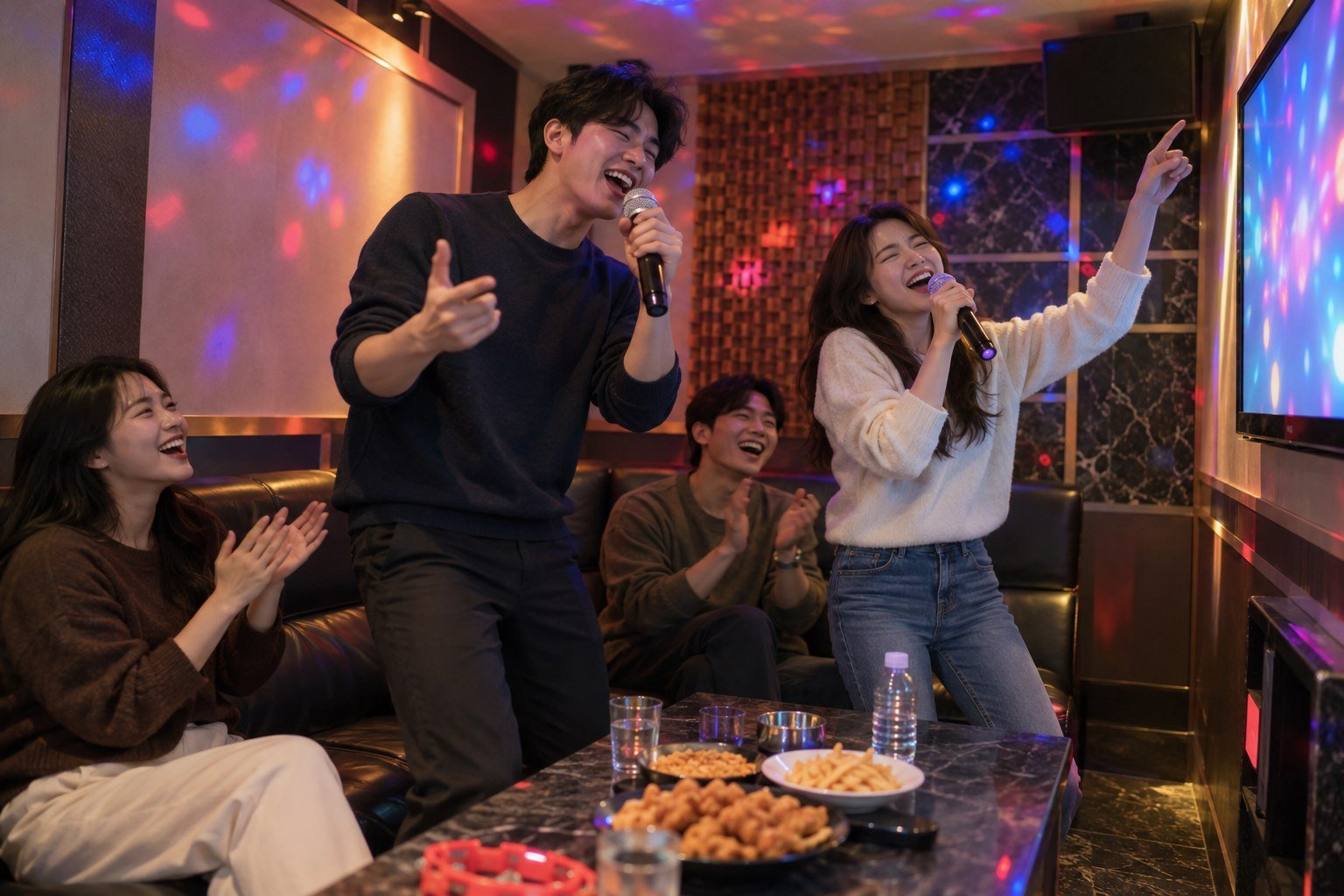
Korea’s 노래방 (no-rae-bang, “song room”) is a private room with a screen, a song machine, two microphones and, mysteriously, a tambourine. According to the Busan Ilbo, the Korean version started in April 1991 in a games arcade near Dong-A University in Busan, where the owner rigged a karaoke machine into a small booth at 300 won a song. By the next year there were more than 10,000 registered song rooms nationwide, and the count peaked at 37,568 in 2005. “2차는 노래방!” became one of the most shouted sentences of the 1990s.
It’s also the round with the most unwritten rules. Here they are:
- Read the room with your song choice. The first songs set the mood, so start upbeat. Opening with a seven-minute heartbreak ballad is the karaoke version of bringing up your ex at dinner. If older people are there, a well-known trot song or a classic ballad they know earns you real goodwill. That’s nunchi with a microphone.
- Everyone has an 18번. Your signature song is called your 십팔번 (sip-pal-beon, “number eighteen”). Have one ready. Even attempting a Korean song gets a cheer.
- Don’t hog the mic. Queue one song at a time, not five. Stacking your own back-to-back is like eating all the meat off the grill.
- The tambourine is a job. When you’re not singing, you’re the audience: clap, sing the chorus, shake the tambourine, do the call-and-response bits. Staring at your phone while a friend gives everything to a ballad is the real rudeness. Nobody cares if you can’t sing. Everyone cares if you don’t hype.
- The 취소 button is a weapon. The cancel button (취소, chwi-so) stops a song mid-chorus. Pressing it on a friend’s song is a classic prank among close friends and a declaration of war among everyone else. Know which group you’re in.
The 노래방 has survived the decline of the long night better than the bars. In NH NongHyup Bank’s 2026 card data, people in their 20s made up 57.7% of all noraebang payments in the first half of the year. The young drink less. They have not stopped singing.
4차: soup at dawn
The final round isn’t drinking at all. Well, mostly. It’s 해장 (hae-jang), the art of settling the morning-after stomach, and its sacred food is 해장국 (hae-jang-guk), hangover soup.
The usual suspects: bean-sprout rice soup (콩나물국밥), dried pollack soup (북엇국), pork-bone soup (뼈해장국), and the hardcore option, ox-blood soup (선지해장국). Hot, spicy broth at 5 a.m., eaten in near silence while the first trains start running. Few moments in Korean life are more peaceful.
Here’s the funny part. The Standard Korean Language Dictionary defines 해장 as “relieving the previous day’s alcohol” or “drinking a little alcohol with hangover soup to do so.” The national dictionary officially recognizes the hair of the dog. Koreans call it 해장술 (hae-jang-sul), and it’s the reason some 4차 tables still have a green bottle on them.
The convenience-store pre-game
The modern 해장 starts before the drinking. Walk into any Korean convenience store before 7 p.m. on a Friday and watch people buy small glass bottles or pocket-sized jelly sticks at the counter, then knock them back in the doorway like athletes before a race.
It’s a big business. Hankook Today, citing the Korea Health Functional Food Association, put the hangover-remedy market at about 350 billion won in 2024. Since 2025, food safety regulators have required products to prove their effect in human trials before they can say 숙취해소 (“hangover relief”) on the label. Tastes are shifting too: Money Today reported in June 2026 that GS25’s hangover product sales grew 17.8% in 2023, 15.0% in 2024 and 14.5% in 2025, with fruit-flavored jellies and pills now growing far faster than the classic drinks.
The ads are an art form in themselves. In 2026, Condition parodied the K-pop nickname “장카설유” (for four famous girl-group members) by casting four middle-aged entertainers whose names happen to start with the same syllables: Jang Kiha, Car the Garden, Seol Woon-do and Yoo Byung-jae. Money Today reported the videos passed 11 million YouTube views.
Who pays? (The short answer)
Often a different person picks up each round. One friend gets dinner, another covers the 2차, someone else pays for the 노래방. It’s a way of sharing the night without splitting every bill to the won, and it keeps the evening feeling like 우리 (uri, “us”) rather than a set of separate tabs. The full politics of the bill deserve their own article.
The long night is getting shorter
If all this sounds exhausting, a lot of Koreans agree.
The clearest recent evidence comes from card data. In September 2026, Yonhap reported on an NH NongHyup Bank analysis of 127 million card payments by 7.38 million customers. Payments at ordinary bars in the first half of 2026 were down 34% from the first half of 2023. For people in their 20s, the drop was steepest: if 2023 is 100, 2026 was 48. And the later the hour, the bigger the fall: bar payments from 6 to 7 p.m. dropped 29%, but those after 1 a.m. dropped 43%. The bank read that as the “2차, 3차” late-night culture fading. Swimming pool payments rose 59%. Laps are beating rounds.
Surveys say the mood has changed as well as the numbers. In a Pickply survey of 1,001 consumers in January 2026, 46.1% said they drink less than a year earlier. Among people who had been to a drinking gathering in the previous three months, only 2.1% said it felt coercive; 45.2% said turning down a drink was fine, and 35.1% said everyone just drank at their own pace.
So the four-round night still exists, especially at reunions, festivals and any gathering where “it’s been so long!” is said more than twice. But “let’s just do 1차” is now a perfectly normal sentence, and nobody thinks less of you for it.
Say / Mean: “딱 1차만 하자” (ttak il-cha-man ha-ja, “Let’s do just one round”) means exactly that about half the time. The other half, it means “I’m saying this so I can blame you at 2 a.m.” Watch who says it. If it’s the person who suggested 3차 last time, book a taxi now.
How to bow out without starting a negotiation
You will reach a point where your body files a formal complaint. Here’s how to leave gracefully.
Leave between rounds. The pavement moment, when everyone’s debating where to go next, is your door. You’re not interrupting a table, just not walking with the group.
Say goodbye. Don’t ghost. A quick farewell to the person who organized the night (and whoever paid the round you just finished) matters more than how long you stayed. If there’s someone clearly older or more senior in the group, tell them first.
Have your lines ready.
| Say this | Romanization | What it does |
|---|---|---|
| 나 먼저 들어갈게! | na meon-jeo deu-reo-gal-ge | “I’ll head home first!” The casual standard among friends. |
| 저 먼저 들어가 보겠습니다. | jeo meon-jeo deu-reo-ga bo-get-seum-ni-da | The polite version, for older people in the group. |
| 내일 일찍 일어나야 돼서. | nae-il il-jjik i-reo-na-ya dwae-seo | “I have to get up early.” Nobody argues with this one. |
| 오늘 잘 먹었어, 고마워! | o-neul jal meo-geo-sseo, go-ma-wo | “Thanks, I ate well tonight!” Say it to whoever paid. |
Expect one round of resistance. Someone will say “한 잔만 더!” (“Just one more glass!”) or “벌써 가?” (“Already?”). This is affection, not a contract. Smile, say it one more time, and walk. If you hesitate, you’ll be in the 3차 within ten minutes, holding a tambourine.
Text when you get home. “잘 들어왔어!” (“Got home safe!”) in the group chat is a small, very Korean courtesy. It’s also the moment your mom’s KakaoTalk from 11:52 p.m. (“어디야”, “where are you”) finally gets its reply.
Common mistakes
- Treating dinner as the whole night. Pace yourself; there may be three more chapters.
- Hogging the mic, or opening with your saddest ballad. Save that for 2 a.m.
- Disappearing without a word. A ten-second goodbye beats a perfect Irish exit.
- Feeling guilty about leaving early. It’s more normal now than ever.
- Skipping the soup. If you made it to dawn, you earned the 해장국.
A Korean night out is less a plan than a conversation the group has with itself, round by round: are we still having fun? Do we want more of each other? Some nights the answer is no after dinner, and everyone goes home happy. Some nights the answer is yes until the sun comes up over a bowl of bean-sprout soup. Both are good nights. The trick is just to know which round you’re in.