Friends & Social Life · 호칭 · 12 min read
Oppa, unnie, hyung, noona: why Koreans call friends 'big brother' and 'big sister'
Who says oppa, unnie, hyung and noona, why Koreans use family words for friends, coworkers and strangers, when oppa turns flirty, why the restaurant auntie is 이모 and every shopkeeper is 사장님, and why 아줌마 can start a fight.
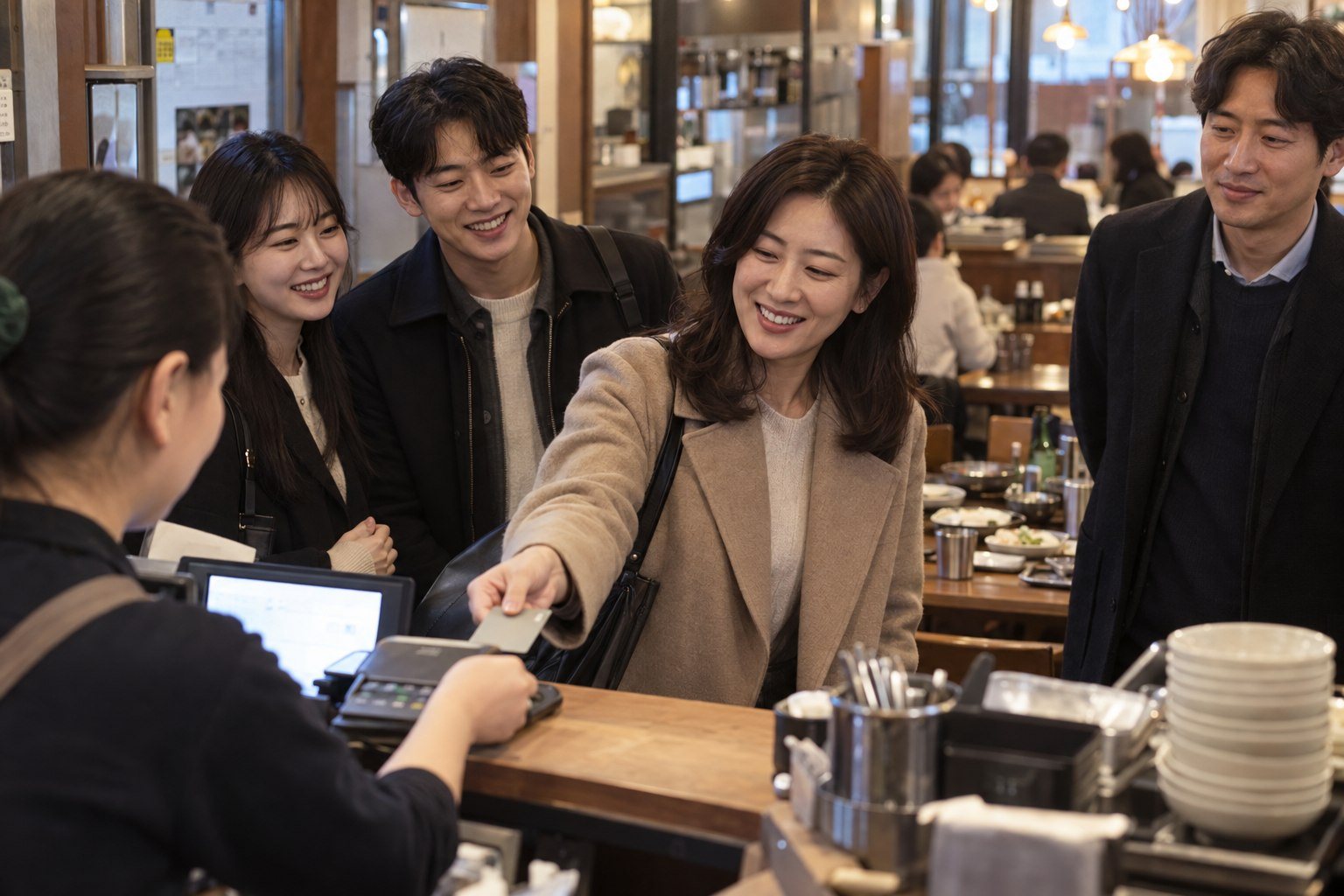
You’ve been in Korea for three weeks. In that time you have learned the following facts.
Your new friend has an older brother named Hyung. So does your coworker. So, apparently, does the guy behind the counter at the PC bang, because a teenager just walked in and said “형, 컵라면 하나요” (“Hyung, one cup noodle, please”). Meanwhile every woman in your office seems to have an older sister called Unnie, and at lunch your Korean colleague called the woman refilling the side dishes 이모, which your textbook says means “aunt”. You did not know they were related. They are not.
Welcome to one of the warmest, most confusing habits in the Korean language: calling people who aren’t your family by family words. Once you understand it, a lot of Korean social life suddenly makes sense.
The short version: Korean has different words for “older brother” and “older sister” depending on whether the speaker is a man or a woman: men say 형 (hyung) and 누나 (noona), women say 오빠 (oppa) and 언니 (unnie). Koreans use them for older friends, seniors and sometimes strangers, as a sign of closeness. Oppa can be flirty. Restaurant staff often get 이모 (auntie) or 사장님 (boss). 아줌마 (ma’am, roughly) can offend, so skip it. When unsure, 저기요 (“excuse me”) is the safest word in the country.
The big four, and why your gender decides which one you say
In English, an older brother is an older brother no matter who’s talking. In Korean, the word changes with the speaker:
| You are | Calling an older man | Calling an older woman |
|---|---|---|
| A man | 형 (hyung) | 누나 (noona) |
| A woman | 오빠 (oppa) | 언니 (unnie) |
So a man never calls anyone oppa, and a woman never calls anyone hyung. (Almost never. When a guy calls his best friend 오빠 to annoy him, it’s funny precisely because it breaks the rule.)
The younger person in all of these pairs is your 동생 (dongsaeng): a younger sibling, and by extension any younger friend. “아는 동생” (“a dongsaeng I know”) is how Koreans introduce a younger friend, and it sounds affectionate rather than dismissive. You don’t call a younger person “dongsaeng” to their face, though; you just use their name.
The order matters because, as we explain in why Koreans ask your age, Korean grammar has a seat for everyone, and age decides who sits where. Once two people know who’s older, the younger one usually reaches for one of these four words.
“But we’re not related”: using family words for friends
None of this is slang. Korea’s Standard Korean Language Dictionary lists the non-family meaning right alongside the family one. Its entry for 언니 includes, as a second sense, an older woman addressed “warmly and respectfully” by a younger woman who isn’t related to her. The dictionary’s entry for 오빠, as the National Institute of Korean Language (NIKL) quoted it in a 2026 Q&A, likewise has a second sense: what a younger woman calls an older man “정답게”, warmly.
That word “warmly” is the key. Calling someone 형 or 언니 isn’t just a label for “older than me”. It’s a small declaration: you’re one of mine. Korean social life runs on a family model, and these words pull a friend inside the circle. It also carries a deal, and every Korean knows the terms:
- The younger one shows respect, keeps polite speech until invited to drop it, and pours the drinks.
- The older one looks after the younger one, gives advice nobody asked for, and, very often, pays.
That last clause is not a joke. “형이 쏜다!” (“Hyung’s buying!”) is one of the happiest sentences in the Korean language, and one of the most expensive.
When does someone become your hyung or unnie? Usually not on day one. You meet, you figure out ages, you stay polite. Then at some point, often over food or drinks, someone says:
Say / Mean: “편하게 언니라고 불러.” (pyeon-ha-ge eon-ni-ra-go bul-leo) says “Just call me unnie, make it comfortable.” It means “I like you, and I’m officially upgrading you from acquaintance to little sister.” The male version is “형이라고 불러.” Accept it. If you’re the older one, saying it first is a generous move.
When oppa becomes flirty
Of the four, 오빠 is the one with a second life.
Yes, a woman can call her actual brother oppa, or a male friend a couple of years older. But in Korean dating, oppa is also what many women call a boyfriend who is older, and the switch from his name (or 선배) to 오빠 can feel like a relationship milestone. K-drama writers know this well: the heroine who finally says “오빠” in episode 8 is not discussing family trees.
Hence the classic cringe line “오빠 믿지?” (“You trust oppa, right?”), which Koreans have long joked is the universal signal of a man about to do something untrustworthy. And there’s the K-pop fan version: thousands of fans screaming “오빠!” at an idol who may well be younger than half of them. A 34-year-old office worker shrieking oppa at a 19-year-old singer is grammatically wrong and emotionally completely correct. In fandom, oppa stops meaning “older man” and starts meaning “the man I adore”.
Because of all this, oppa needs some care. NIKL, asked in 2026 whether a young woman could call a man 40 years older oppa at a first meeting, said that the “warmth” in the dictionary definition assumes a real bond already exists, so it isn’t natural on first meeting, and that a gap of around 40 years is closer to a parent’s generation, making oppa inappropriate. In other words: the word is for people you’re close to, not a free-floating compliment. (If you’re dating, our guides to Korean boyfriends and Korean girlfriends go into what the titles mean between couples.)
이모, 언니, 사장님: the restaurant family you didn’t know you had
Now for the part that confuses visitors most. Walk into a busy Korean restaurant and listen. You’ll hear customers call the staff:
- 이모 (i-mo), “auntie”, literally your mother’s sister. The Standard Korean Language Dictionary gives exactly one meaning: your mother’s sister. Not your father’s sister, not a waitress, not anyone at a pork-belly restaurant. And yet, at the kimchi stew place where you’ve eaten every Tuesday for a year, the woman who knows your order and slips you an extra fried egg is your 이모. She is definitely not your aunt. Your mother has never met her. Nobody cares.
- 삼촌 (sam-chon), “uncle”, the male version, for a man working the grill or delivering.
- 언니 (eon-ni), used by women customers for a woman server, especially one around their age or a little older.
- 사장님 (sa-jang-nim), “boss” or “company president”. Originally for the owner, now used for almost anyone behind a counter, from the man at the hardware store to the 20-year-old part-timer at the chicken place who is very much not the president of anything.
The linguist Robert Fouser, writing in the Hankyoreh in 2024, described hearing 사장님, 여기요 and 이모 all at one lunch, and noted that 사장님 has become the term he hears most. Everyone knows the server isn’t the owner, he pointed out; the word is popular because it keeps a polite distance. 이모, by contrast, is what regulars use to show warmth. An older MBC report from 2011 cited a survey in which family-style terms like 이모 were the most-used way to call restaurant staff, at about 32%, ahead of 아줌마 at 26%.
Calling someone 이모 turns a transaction into a relationship: I’m not just a customer, I’m practically family. And in Korea, family gets bigger portions. (Or so every regular believes.)
For the full menu of restaurant manners, from the table bell to who pays, see our Korean restaurant guide.
어머님, 아버님, and the strangers who become your parents
The family logic goes up a generation too. A friend’s parents, older shop owners or the woman selling fruit at the market may be addressed as 어머님 (eo-meo-nim, respected mother) or 아버님 (a-beo-nim, respected father): respectful, and no personal details required. Salespeople use it a little too enthusiastically, which is how a 45-year-old ends up startled to be called 어머님 by a 30-year-old phone salesman. If you’re meeting a partner’s parents, these are also the words you’ll want; we cover that in meeting your Korean partner’s parents.
아저씨 and 아줌마: handle with care
아저씨 (a-jeo-ssi) and 아줌마 (a-jum-ma) are the default words for a middle-aged man and woman you don’t know. They’re in every textbook. They are also, especially 아줌마, the ones most likely to land badly.
The dictionary itself hints at why: it defines 아줌마 as a way of addressing an 아주머니 (a married or older woman) “in a friendly way or a lowering way”. Friendly or lowering. That’s a lot riding on your tone.
The numbers back it up. In a NIKL survey reported by Edaily in 2018, 46.6% of people working in service jobs said being called 아저씨/아주머니 by customers was unpleasant, and women (58.4%) minded far more than men (37.8%). In 2023, a Chosun Ilbo survey of 2,008 women in their 30s to 60s found that 64% of women in their 30s and 60% in their 40s disliked being called 아줌마. The most common reason was simple: “Because I don’t think I’m an 아줌마.” Asked what decides whether someone “is” one, the top answer was appearance, ahead of marriage or age. So calling someone 아줌마 is, in effect, an unsolicited verdict on how old she looks. No wonder it stings. Meanwhile 70% of men in the same survey didn’t mind 아저씨.
The practical lesson: 아저씨 for a taxi driver or the man fixing your boiler is mostly fine. 아줌마 is best left alone. There are better options below.
선배, 후배, 막내: the school and office family
Outside the family words, Korean has a parallel system for people who started before or after you.
- 선배 (seon-bae): someone ahead of you in the same field, by position, age or experience, as the dictionary puts it. At school, it’s anyone in an older year; at work, someone who joined earlier.
- 후배 (hu-bae): the reverse, someone who came after you.
- 막내 (mak-nae): strictly, the youngest of several siblings. In practice, the youngest member of any group: the newest hire, the junior in the club, the youngest member of a K-pop band. Being the 막내 comes with duties (setting out the spoons and chopsticks at a team dinner, ordering the food, laughing at the boss’s dad jokes) and privileges (everyone thinks you’re adorable).
The move from 선배 to 형 or 언니 is meaningful: the first is respect, the second is friendship.
형님: gangster movies and middle-aged men
Add -님, the honorific suffix, and 형 becomes 형님 (hyeong-nim), “honored elder brother”. It’s the official respectful version. But culturally it has a very particular flavor.
In Korean gangster films, 형님 is what a row of men in black suits bellow at the boss: a corridor, thirty tough guys, ninety-degree bows, “형님, 오셨습니까!” (“Hyungnim, you’ve arrived!”). So calling a friend 형님 with a big bow is a guaranteed laugh.
Away from the movies, 형님 is very much alive among middle-aged men: older in-laws, senior colleagues who’ve become friends, the men in a hiking club. It signals respect plus loyalty, often with a grin over the second bottle of soju. (A woman also uses 형님 for her husband’s older brother’s wife, but that family tree is another article.)
Foreigners using these words: cute or awkward?
Mostly cute, when it fits. Koreans are usually delighted when a foreign friend calls them 언니 or 형. A few pointers:
- Get the gender right. Use the table above.
- Wait for the invitation, or at least for the friendship. Calling your new manager 언니 on day two skips several important steps. Use her name and title until she suggests otherwise. (Our article on nunchi will help you read when the moment has come.)
- Mind the oppa effect. If you’re a woman, calling a man 오빠 may be heard as friendly, or as flirtatious, depending on context and tone. If you don’t mean the second, a name plus 씨, or 선배, is safer.
- 이모 is earned. At your regular place, after a few visits, 이모 can be charming from a foreigner. At a restaurant you’ve never entered before, 저기요 or 사장님 is the safer bet.
- Don’t overthink it. A warm mistake usually beats a cold, careful silence.
How it’s changing
The family-word system is still strong, but it’s shifting, especially at the counter.
Not every worker wants to be anyone’s 언니 or 이모. Back in 2011, a Korean women’s group ran a public contest for a respectful new word for restaurant workers and picked 차림사 (“the person who sets the table”), MBC reported; it never caught on. In 2012 the women’s newspaper Yeosung Shinmun profiled a small Seoul restaurant that banned 아줌마, 이모, 언니 and even 저기요, and had customers call the server by name. And the drift Fouser describes, towards 사장님 and 저기요, is partly about keeping a respectful distance. In a 2022 survey by the job site Albacheon of 1,652 young part-time workers, cited by the Chosun Ilbo, the term they most liked being called was 저기요 (36.3%), ahead of 사장님 (22.3%) and 선생님 (11.7%). NIKL itself has suggested gender-neutral, job-based terms; an official quoted in the 2018 Edaily piece recommended 사장님 or 종업원님 for restaurant staff regardless of position or gender.
Inside companies, many Korean firms have tried flattening titles altogether by calling everyone “이름 + 님” (name plus -nim), so that a team leader and a new hire are both, say, “민준님”. It hasn’t erased old habits everywhere: one employee told the Chosun Ilbo that some bosses still use casual speech with juniors, whatever the email signature says.
None of this means 언니 and 형 are going anywhere between friends. The change is about where the family stops: more Koreans want it to stop at their actual friends, not extend to everyone holding a menu.
What to actually say: a cheat sheet
| Situation | Safe choice | Warmer, once you know them |
|---|---|---|
| Calling a server you don’t know | 저기요 (jeo-gi-yo), or press the table bell | 사장님, or 이모/삼촌 at your regular place |
| An older friend (you’re a man) | Name + 씨, or 선배 | 형 / 누나 |
| An older friend (you’re a woman) | Name + 씨, or 선배 | 오빠 / 언니 |
| A younger friend | Their name | 동생, or their name with -아/-야 |
| A friend’s or partner’s parents | 어머님 / 아버님 | Same, forever |
| A middle-aged stranger | 저기요, then polite speech | 사장님 if they’re behind a counter |
| Someone you’d call 아줌마 | Anything else | Still anything else |
Common mistakes:
- Mixing up the gender of the speaker. Men: 형 and 누나. Women: 오빠 and 언니.
- Upgrading too fast. Family words come with friendship. Wait for the “편하게 불러” moment.
- Using 아줌마 to get someone’s attention. Say 저기요 instead.
- Forgetting the deal. If you’re the 형 or 언니, sooner or later the bill is yours. Budget accordingly.
- Taking 이모 literally. “Dinner at my 이모’s place” might mean a mother’s sister. Or a soup restaurant. Ask.
Being called 언니 or 형 in Korea isn’t just about age. It means someone has decided you’re part of their people. When it happens, enjoy it. And when you hear a crowd of fans screaming 오빠 at a teenager, or a whole restaurant calling one cheerful woman 이모, you’ll understand: in Korea, family is a lot bigger than your family tree. (Holding hands with friends is part of the same story.)