Friends & Social Life · 단톡방 · 12 min read
Your first Korean group chat: KakaoTalk read receipts, reactions and the art of silence
How the KakaoTalk 단톡방 works: the unread '1', 읽씹 vs 안읽씹, ㅋㅋㅋ vs ㅎㅎ, paid emoticons, work chats after hours and the right-to-disconnect debate, family good-morning images, reactions, leaving quietly and the polite habits that keep you out of trouble.
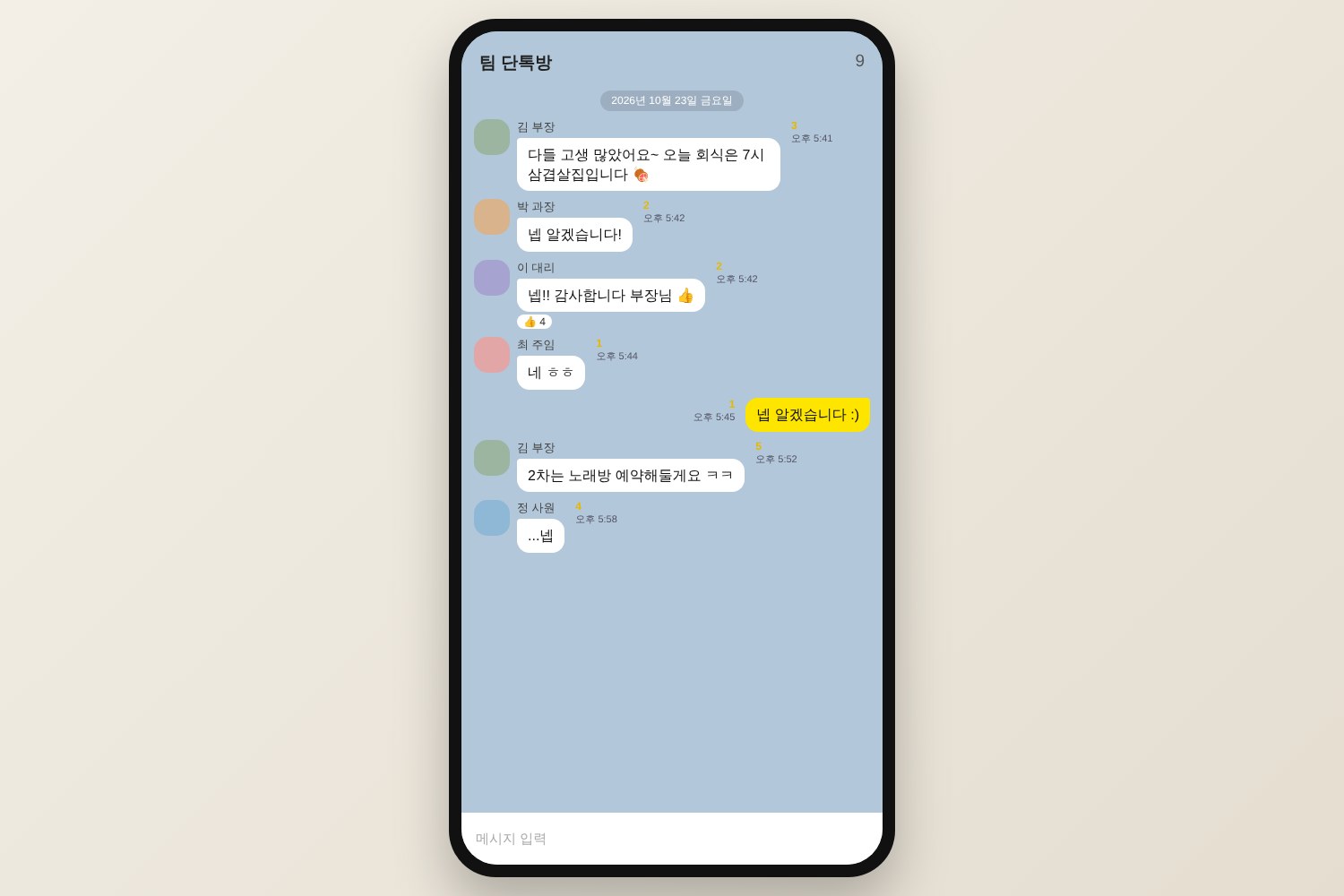
Your phone buzzes. Then it buzzes again. Then it buzzes eleven times in a row, like it’s trying to escape your pocket.
You’ve been added to a KakaoTalk group chat: your new team, your Korean class, or your partner’s family. The room has a name like “🔥팀 화이팅🔥” and someone has already posted a welcome sticker of a bear doing a backflip. Under your first message, a small yellow number sits there: 5. Then 3. Then 1.
And then it stays at 1 for forty minutes, and you start wondering who it is, what they’re doing, and whether they hate you.
Welcome to the 단톡방 (dan-tok-bang), the group chat room, where a surprising amount of Korean social life happens. It has its own grammar, its own crimes and its own unwritten rules.
The short version: almost everyone in Korea is on KakaoTalk, and its unread number tells everyone who has read what. Answer seniors and bosses quickly and politely (“네, 알겠습니다!”), use reactions for small acknowledgments, don’t spam ㅋㅋㅋ in formal rooms, never leave a work chat on your own, and treat after-hours work messages with some care, because Korea is debating whether they should be legal at all. In family chats, reply to the good-morning image. Yes, every one.
Why everyone is in the same app
Elsewhere, your messages are scattered across four apps. In Korea, there is one. KakaoTalk launched on March 18, 2010, and the Korean verb for “message me” quietly changed from “send a text” to “카톡해” (“Kakao me”).
The numbers are almost silly. In its earnings release for the second quarter of 2026, Kakao reported 49.63 million domestic monthly active users for KakaoTalk, in a country of about 51 million people. Your landlord is on it. Your manager is on it. Your partner’s grandmother is on it, with a profile photo of a lotus flower.
So a group chat in Korea isn’t a side channel. For many groups it is the group: class announcements, wedding invitations, funeral notices, team schedules, the hiking club’s Sunday plan. If you’re not in the room, you’re not in the loop.
The tyranny of the number “1”
Every message you send on KakaoTalk carries a small yellow number. In a one-on-one chat it’s a 1 that disappears when the other person opens the message. In a group chat, the number shows how many members haven’t read it yet, and it counts down as people open the room.
This tiny feature has caused more Korean anxiety than most horror films. You always know that someone read your message, never why they haven’t answered. So Korean has two words for it, both in the National Institute of Korean Language’s open dictionary, Urimalsaem:
| Slang | Short for | What it means | How it feels |
|---|---|---|---|
| 읽씹 (ik-ssip) | 읽고 씹기, “read and chew (ignore)” | They read it and didn’t reply. The 1 is gone. | Personal. Mildly devastating. |
| 안읽씹 (an-ik-ssip) | 안 읽고 씹기, “didn’t read, ignored” | They haven’t even opened it. The 1 is still there. | Maybe they’re busy. Maybe they’re avoiding you. Possibly both. |
Koreans can argue over soju for hours about which is worse. Team 읽씹 says at least 안읽씹 leaves room for hope. Team 안읽씹 points out that the person had time to post on Instagram. There’s also a whole folk science of reading a message in the notification preview without making the 1 disappear, to buy time before you’re officially on the record.
What this means for you: the 1 is a social signal. A quick reply says you’re attentive. A long 읽씹 from a junior to a senior can read as rude, and between friends, three days of silence will be noticed even if nobody says so. That’s nunchi in digital form: everyone is reading the room, and the room has a counter.
ㅋㅋㅋ, ㅎㅎ and the art of sounding like a person
Korean chat has its own laughter. The two big ones:
- ㅋㅋㅋ comes from 크크 or 키키, a giggle. It’s the default “lol”. More ㅋ means more laughing. ㅋ alone can feel dry or even sarcastic; ㅋㅋㅋㅋㅋㅋㅋㅋ means you are actually crying on the subway.
- ㅎㅎ comes from 하하 or 히히. It’s softer, closer to a smile than a laugh. Many people use it to warm up a sentence that might otherwise sound stiff: “네 알겠습니다 ㅎㅎ” (“Yes, understood :)”).
As a rough, observed rule: ㅋㅋㅋ is for friends and peers, ㅎㅎ is the polite smile you can sometimes use with people you’re less close to, and in a formal work chat or with someone much older, you may want neither until you see what everyone else does. Copy the room. If the team leader writes “ㅎㅎ”, you’ve been given a small permission.
The same goes for “yes”. 네 is plain, and can feel cold in text. 넵 is crisp and eager, the office worker’s favorite. 넹 and 네네 are softer. Some people genuinely agonize over 넵 versus 넵!. You don’t have to: “네, 알겠습니다!” will see you through most situations.
Emoticons: the paid language of feelings
Then there are the stickers, which Koreans call 이모티콘 (emoticons). These aren’t the free emoji on your keyboard. They’re animated characters, sold in sets, that do the emotional heavy lifting: a rabbit bowing ninety degrees, a cat collapsing from overwork, a bear holding a sign that says “감사합니다”.
Kakao first launched emoticons in November 2011. By its tenth anniversary in 2021, the company said there were about 300,000 individual emoticons, that users had sent more than 220 billion of them, and that the emoticon business had grown into a market worth around 700 billion won. 1,392 sets had each earned over 100 million won, and 92 had passed a billion. “Emoticon artist” is a real job, and there’s now a subscription, 이모티콘 플러스, for people who can’t stop buying sets.
The etiquette is tone matching. A bowing or thank-you emoticon after a senior’s message is normal in many work and club chats. A sticker as your only answer to a real question is not: “bear doing a thumbs-up” doesn’t answer “Can you send the file by 3?”
The 단톡방 at work: answer fast, leave never
Picture it. It’s 9:40 p.m. You’re on the sofa. The team leader posts in the room: “내일 회의 10시로 변경합니다.” (“Tomorrow’s meeting moves to 10.”) Within ninety seconds, the replies stack up like a row of bowing employees:
네 알겠습니다! 넵 알겠습니다! 네 확인했습니다!
Nobody asked anyone to reply. Everyone replies. In many teams juniors are expected to join this reply chain, so the senior knows the message landed, and because silence stands out when the 1 has already told the room you read it.
Say / Mean: “네, 확인했습니다!” (ne, hwa-gin-haet-seum-ni-da) says “Yes, I’ve checked it.” In a work chat it means “I saw this, I’m on it, and I am a reliable member of this team,” which is exactly what you want to say in about four words.
A few more rules most Korean office workers would recognize:
- Never leave a work chat on your own. Even if it’s dead. Even if the project ended in 2023. Leaving can look like you’re cutting ties with the team. Mute it instead; that’s what the bell icon is for.
- Don’t argue in the group. If you disagree with your boss, a private message or a quiet word in person is far safer than a debate in front of twelve colleagues. (Our guide to why Koreans don’t say no explains why.)
- Watch the clock when you’re the one sending. If you have to message after hours, many people add “늦은 시간에 죄송합니다” (“Sorry for the late hour”) and make it clear it can wait until tomorrow.
After hours: the right-to-disconnect debate
That 9:40 p.m. message is exactly what Korea has been arguing about for a decade.
In June 2016, lawmaker Shin Kyung-min proposed an amendment to the Labor Standards Act, quickly nicknamed the “퇴근 후 업무 카톡 금지법” (“ban on work KakaoTalk after hours”), which would have barred employers from giving work orders by phone, text or social media outside working hours. He called it the “right to disconnect” (연결되지 않을 권리). It didn’t pass, but the phrase stuck.
The problem didn’t go away. In a survey for the civic group Workplace Gapjil 119, conducted by Global Research among 1,000 workers in October 2025 and published in February 2026, 66% said they’d been contacted about work after hours, on weekends or on holidays in the past year. Among those, 30.8% had received work contact after 10 p.m. And 80.5% said Korea needs a law banning work contact after hours.
The government has taken up the idea as part of its push to cut real working hours. By mid-2026, a working-hours bill and a Labor Standards Act amendment spelling out the right to disconnect were before the National Assembly’s labor committee. Business groups worry about where “unnecessary” contact begins; unions want firm rules. (For the bigger story of Korean work hours and the generation that leaves at 6:00 sharp, see our piece on 칼퇴 and MZ work culture.)
Meanwhile, plenty of teams set their own rules, like “urgent only” after 7. Follow yours. If there isn’t one, answer what’s genuinely urgent, and use the scheduled-message feature for anything you send that can wait.
The family chat: roses, sunsets and black ribbons
If the work chat is the office, the family 단톡방 is the living room, and it has a very particular décor.
Every morning, somewhere in Korea, a parent sends a good-morning image (좋은 아침 이미지): a glittering rose, a waterfall, a cup of coffee on a windowsill, with “좋은 아침입니다” or a line about health and happiness written in shimmering gold calligraphy. Sometimes it sparkles. Sometimes it plays music. It’s one of the most beloved and gently mocked genres in Korean digital life. Younger Koreans joke about it endlessly, then quietly send a heart back, because they know exactly what it means: I’m thinking of you, I’m still here, please eat breakfast.
The rules of the family chat:
- Acknowledge the parents. A sticker, a heart or “엄마도 좋은 하루 보내세요!” (“Have a good day too, Mom!”) is plenty. An unanswered family message has a way of turning into a phone call that begins with “왜 답이 없어?” (“Why no answer?”).
- Expect forwarded health advice. Ginger cures everything, apparently, and so does walking backwards. You don’t have to fact-check your uncle in the group. A polite “네~” keeps the peace.
- If you’re the partner, being added to the in-law chat is a sign of acceptance. Greet people, answer the elders, and let your partner handle anything delicate.
The family and work chats are also where the most serious messages arrive. A 부고 (bu-go), a death notice, usually comes as a formal message with a black ribbon, the name of the deceased, the funeral hall, the room number and the date of the burial procession. This is not a moment for ㅋㅋ or a cute sticker. A short, formal message of condolence is right, and if you’re close, you go. Our funeral etiquette guide walks you through what to do next.
Reactions: the “I saw it” button
For years, the only way to acknowledge a message was to reply, hence the reply chain. Then, in August 2021, Kakao added emoji reactions to chat messages: long-press a bubble and leave a heart, a thumbs-up, a check mark and a few others. Kakao calls them 공감 (gong-gam), roughly “empathy” or “agreement.”
A ✔️ on the boss’s schedule change, a ❤️ on mom’s rose: no notification storm. In May 2026, Kakao expanded the set from 6 reactions to 114 and allowed up to 30 reactions per message, including the small “mini emoticons,” so you can now react to your manager with a tiny bowing bear.
Is a reaction a full reply? Among friends, yes. At work, many people still answer a direct instruction in words and save reactions for announcements. Watch what the people one rank above you do.
Leaving quietly, and why it took a whole feature
For most of KakaoTalk’s life, leaving a group chat came with a public announcement: “○○님이 나갔습니다” (“○○ has left”). Everyone saw it. In a culture where the group matters a lot (the idea Koreans call 우리, “we”), walking out with a notice like that can feel like slamming a door.
So people stayed, in zombie chats from old part-time jobs, finished school projects and a wedding that happened in 2019. Kakao first offered quiet leaving only in paid team chat rooms in December 2022, and in May 2023 it added “채팅방 조용히 나가기” (“leave chat room quietly”) to the app’s Labs (실험실) menu, so the “has left” message no longer appears to everyone else. Kakao’s press release said it was for chats people had “missed the timing” to leave. That a messaging company needed a feature for this tells you most of what you need to know.
Even so, quiet isn’t invisible. Someone may notice the member count dropped. For old social chats, leaving quietly is fine. For a current work chat or your partner’s family chat, stay and mute.
When the group chat turns cruel
There’s a darker side, and it’s worth knowing the word. 카톡 감옥 (ka-tok gam-ok), “KakaoTalk prison,” describes a form of cyberbullying where a victim is pulled into a group chat and bombarded with insults, and every time they leave, they get invited right back in. In 2020, Yonhap reported on a teenager who described exactly this, being invited again and again into a group chat full of strangers hurling abuse, until she changed her phone number. A quieter cruelty is the “real” group chat everyone is in except one person.
Kakao now lets users accept or decline group invitations from people who aren’t on their friends list. If you see bullying in a chat, screenshots help, and so does refusing to join in.
Gifting in two taps: 선물하기
One of KakaoTalk’s most Korean features is 선물하기 (seon-mul-ha-gi), “send a gift”: pick a coffee voucher, a cake, a chicken set or an emoticon set, tap a name, and a redeemable gift card lands in their chat. It’s the oil in the gears of Korean relationships:
- A coworker covers for you? A coffee voucher with “덕분에 살았어요 ㅎㅎ” (“You saved me”).
- Someone’s birthday pops up in the “friends with birthdays today” list? Many people send a small gift, especially to close colleagues.
- Your boss treated the team? A thank-you message, and maybe nothing more; gifting upward can feel like flattery, so read the team.
Small and thoughtful beats big and showy. A 5,000 won coffee voucher, sent at the right moment, buys more 정 (jeong), that sticky Korean affection, than you’d expect.
Common mistakes (and how to avoid them)
- Leaving a work or family chat. Mute it instead.
- Going silent on a boss or elder after the 1 disappears. Reply, or at least react.
- ㅋㅋㅋ in a formal room. Copy the room.
- A sticker as your only answer to a real question. Words first, bear second.
- Arguing in the group, or messaging at midnight. Take it private; schedule it.
- A cute sticker under a 부고. Formal words only.
- Ignoring mom’s rose. It takes one second. Send a heart.
Your first 단톡방 will feel like a lot: a hundred unread messages after lunch and a number that won’t go away. Give it a week. Watch how people answer the senior, when they laugh, what they react to. Very soon you’ll be the one replying “넵!” in under ten seconds, sending a coffee voucher with a bowing rabbit, and, one fine evening, leaving a dead chat from 2019 without anyone noticing. That’s when you know you’ve arrived.