Friends & Social Life · 먼저 일어나보겠습니다 · 12 min read
먼저 일어나보겠습니다: how to leave a Korean gathering early without making it awkward
Why leaving a Korean dinner or drinking night early feels so loaded, when slipping out quietly works (and when it really doesn't), the excuses nobody questions, the exact phrases, who to say goodbye to first, settling your share, the last train as a sacred exit, and the text you send afterwards.
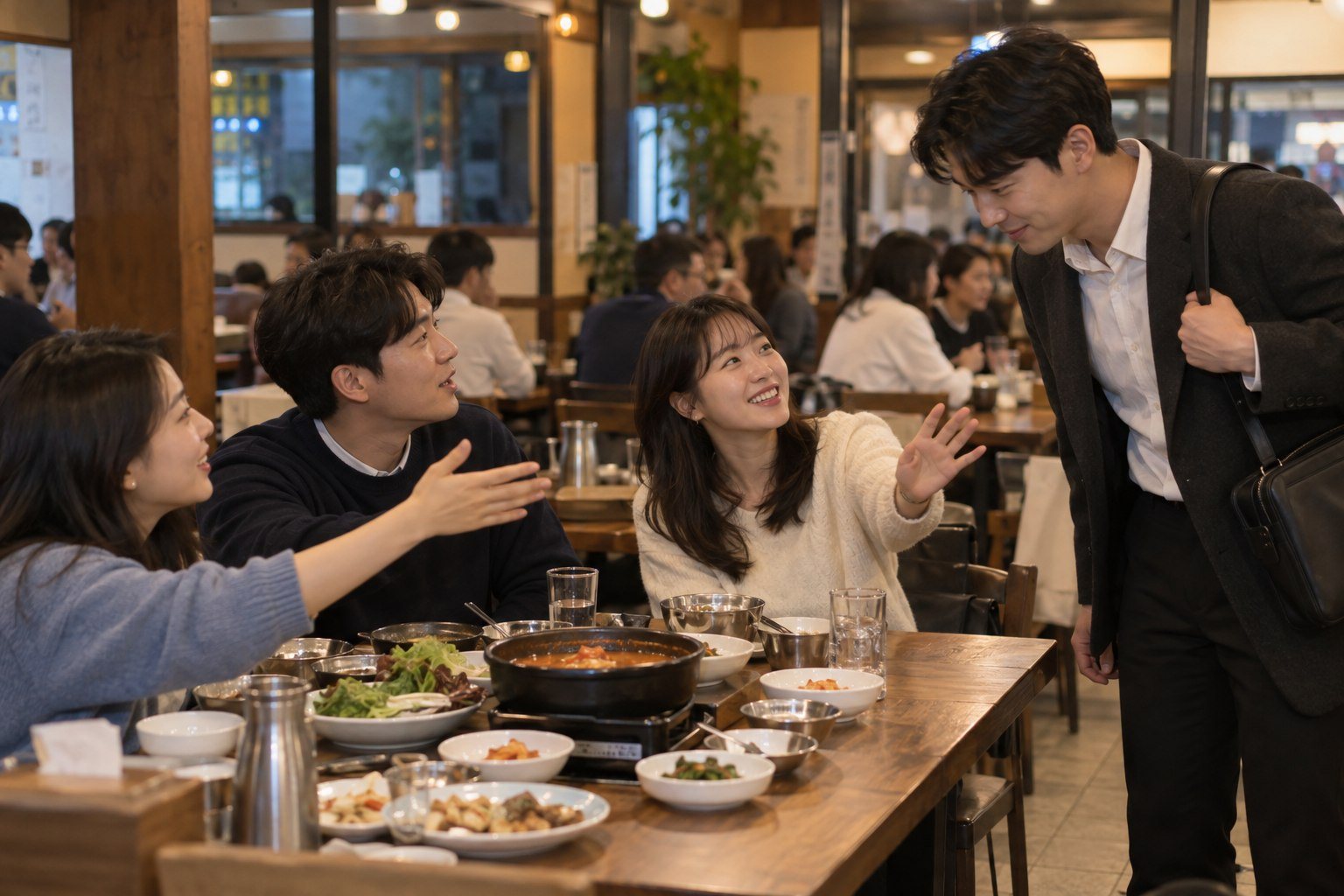
It’s 10:40 p.m. The table is a mess of empty green bottles, the grill has been switched off for twenty minutes, and the most senior person at the table has just started a story with “내가 너희 나이 때는…” (“When I was your age…”). You know this story. It has no ending, only intermissions.
Under the table, your thumb is on your phone. Naver Map says your last train leaves in 31 minutes. Your brain is running two programs at once: “How do I stand up without killing the mood?” and “If I miss that train, a taxi home costs as much as dinner.”
Every Korean has been in this chair. Leaving early isn’t hard because anyone will stop you. It’s hard because standing up says something, and everyone hears it. The good news: there’s a script, and once you know it, you can leave almost any table in under a minute and still be invited back.
The short version: pick a natural break (between rounds is best, a lull in the conversation is fine), give a simple reason nobody will question (막차, work tomorrow, “something at home”), say goodbye to the most senior person first, then the host or whoever’s paying, then the table. Use “먼저 일어나보겠습니다” or “먼저 들어가보겠습니다”, settle your share before you go, accept exactly one round of “벌써 가?”, and walk. Send a short thanks in the chat when you get home. What you shouldn’t do, in most groups, is vanish without a word.
Why standing up feels like pulling a fire alarm
The 분위기 problem
Koreans talk constantly about 분위기 (bun-wi-gi), the mood of a room. A gathering is something the group builds together, and it’s fragile. One of the worst social accusations is 분위기 깨기, “breaking the mood,” and a person in a coat bowing goodbye at 9:15 is a walking mood-breaker. The laughter stops, someone says “벌써?” (“Already?”), and for a second the whole table is thinking about the time, the one thing a good night is supposed to make you forget.
The domino effect
There’s also a quieter fear: being first. The first exit gives everyone else permission. One person says “저 먼저…” and within five minutes three more have remembered early meetings, while the organizer watches the table shrink. So everyone waits for someone else to go first, and the night runs two hours longer than anyone wanted. This is how Korea produces 1 a.m. dinners that nobody, individually, was enjoying.
Somebody older is still sitting there
Then there’s age and rank. Leaving while your boss, your 선배 (senior) or an older relative is still at the table is a bigger deal than leaving friends your own age, because juniors traditionally see seniors off, not the other way around. It’s fine, but it has to be done properly: a small, ritual request and a small, ritual blessing. (More below.) This is nunchi in action: the question isn’t only “do I want to go?” but “what will my leaving mean to the people still here?”
The Korean Irish exit: 몰래 빠지기 and 잠수
English has the “Irish exit” or “Irish goodbye”: leaving a party without telling anyone. Korean doesn’t have one cute name for it. People just describe it: 몰래 빠지기 (mol-lae ppa-ji-gi), “slipping out secretly,” or 조용히 사라지기, “quietly disappearing.”
The slang that takes it further is 잠수 (jam-su). The Standard Korean Language Dictionary lists 잠수 only in its literal sense, “going under water.” In everyday Korean, though, 잠수 타다 means going silent and unreachable; 잠수 이별 is common enough that Health Chosun used it in a 2025 headline for ending a relationship by simply cutting contact. After a night out, “잠수 탔다” means someone left and then didn’t answer the group chat. Your friends have no idea if you’re home, asleep, or in a taxi heading to the wrong city.
When slipping out actually works:
- Big, loose gatherings: a 40-person alumni reunion, a wedding after-party, a club night, a networking event where people drift in and out anyway.
- The 3차 or later, when the group has scattered between the 노래방 room and the smoking area and nobody is counting heads.
- When you’ve already told the host earlier, “I’ll probably have to slip out around eleven.”
When it really doesn’t:
- A table of six. Someone will notice your empty chair in under four minutes.
- Any table with your boss, a senior, or an elder. Leaving without a word here reads as disrespect, not discretion.
- A small dinner where someone is treating everyone. Disappearing before you’ve thanked the person paying is the one thing people will actually talk about.
And beware the classic giveaway: you “go to the bathroom” with your coat still on the back of your chair. Twenty minutes later your phone lights up: “어디야? 화장실에서 길 잃었어?” (“Where are you? Did you get lost in the bathroom?”). A ten-second goodbye costs almost nothing; a silent exit can earn you a reputation as the one who “just disappears.” When in doubt, say goodbye.
The excuses nobody questions
A Korean exit almost always comes with a reason. Not because anyone demands one, but because a reason turns “I want to leave” (which sounds like a judgment on the evening) into “I have to leave” (which sounds like bad luck). These are the classics:
| The excuse | In Korean | What it really signals |
|---|---|---|
| The last train | 막차 시간이 돼서요 (mak-cha si-gan-i dwae-seo-yo) | The most respected excuse in the country. See below. |
| Work tomorrow | 내일 출근해야 돼서요 (nae-il chul-geun-hae-ya dwae-seo-yo) | On a weeknight, unarguable. Works for anyone with a job, and everyone at the table has one. |
| An early start | 내일 아침 일찍 일정이 있어서요 | Slightly more mysterious, therefore slightly more powerful. |
| Something at home | 집에 일이 있어서요 (ji-be i-ri i-sseo-seo-yo) | Gloriously vague. Nobody asks what. It could be a sick parent, a plumber, or a cat who expects dinner at ten. |
Notice that nobody follows up. Asking “what thing at home, exactly?” would be rude, because everyone understands that the excuse is partly a courtesy. It’s the same indirect logic we cover in why Koreans rarely say “no” directly: the words give everyone a way to save face, and the real message (“I’m done for tonight”) arrives safely without anyone having to say it.
Are a lot of these excuses invented? Some, yes. In a small 2024 online survey of 124 office workers by the pharmaceutical company Handok, 62% said they had made up an excuse to skip an evening 회식. The same survey asked when a drinking dinner should end, and 9 p.m. was the most popular answer (44%), followed by 10 p.m. (30%). So if you’re glancing at the clock at 9:30, you’re probably not the only one.
A tip: give the reason once, early, and lightly. Mentioning at the start of the night that you might leave early for the last train makes your exit feel planned, not personal. An elaborate story at 11 p.m. (“my cousin’s dog’s surgery got moved…”) just invites questions.
막차: the most sacred words in Korean nightlife
The dictionary definition of 막차 (mak-cha) is simple: “the vehicle that comes or goes last.” In real life, it’s the closest thing Korea has to a universal hall pass. Say “저 막차 끊겨요!” (“My last train’s about to go!”) and even the most determined 3차 enthusiast will wave you off, because everybody has stood at a dark station watching a timetable that ended ten minutes ago.
So when is it? Seoul’s subway hours were cut back during COVID and restored in 2022 so that late trains reach their final stations around 1 a.m. Note the final station: the last train from your stop may leave well before that, often around midnight depending on line and direction, and transfers make it earlier still. In 2025 Seoul announced a plan to move first and last trains on lines 1 to 8 thirty minutes earlier; by August, the Munhwa Ilbo reported it had stalled amid union opposition. Timetables change, so check Naver Map or Kakao Map when you sit down, not after the fourth bottle.
Miss it and there’s a backup: the late-night 올빼미버스 (ol-ppae-mi beo-seu, “owl bus”), which Seoul introduced in 2013 as the first city in the country to do so. The city says it now runs 14 routes, numbered with an N (N13, N26, N62…), between 11 p.m. and 6 a.m., at 2,500 won by card. They’re a lifesaver, and also slow, with buses every 20 to 40 minutes. “I missed the 막차 and took the N bus” is a story Koreans tell with the solemn pride of someone who survived a winter crossing.
For your exit, that makes the 막차 a socially accepted deadline. It’s not you leaving; it’s the train leaving, and you’re simply going with it. Nobody blames you for public transport.
Say / Mean: “저 막차 시간 돼서 먼저 일어나보겠습니다” (jeo mak-cha si-gan dwae-seo meon-jeo i-reo-na-bo-get-seum-ni-da) says “It’s time for my last train, so I’ll get up first.” What it means is “I’m leaving, I respect this table, and it’s not personal.” It works at almost any gathering, with almost any boss. Just don’t use it at 8:30 p.m. Everyone knows roughly when the trains stop.
The phrases: getting up vs going in
Two near-identical sentences do most of the work, and the difference between them is small but nice to know.
먼저 일어나보겠습니다 (meon-jeo i-reo-na-bo-get-seum-ni-da), literally “I’ll try getting up first.” This is the sentence for the moment you stand up from the table. It describes the act of leaving the seat, so it fits restaurants, dinners at someone’s home, meetings and any gathering where everyone’s sitting.
먼저 들어가보겠습니다 (meon-jeo deu-reo-ga-bo-get-seum-ni-da), literally “I’ll try going in first.” Koreans “go in” (들어가다) to their homes, so this means “I’ll head home.” It’s the classic end-of-workday line, and it fits the pavement outside the restaurant, where there’s no seat left to get up from.
That -보겠습니다 (“I’ll try to…”) is a softener. You’re not announcing “I’m leaving”; you’re humbly suggesting you might give leaving a go, if that’s all right. Adding 죄송하지만 (“I’m sorry, but”) in front softens it further, a good idea when seniors are present. (Why 수고하셨습니다 is a risky goodbye to a senior is its own story.)
Then there’s the line for the people who stay: 즐거운 시간 보내세요 (jeul-geo-un si-gan bo-nae-se-yo), “Have a good time.” It sounds small, but it’s a gift. It tells the table that the party is still on, they’re allowed to keep going, and you’re not taking the fun with you. It’s the verbal equivalent of closing the door gently.
Among friends your own age, it all shrinks: “나 먼저 간다! 재밌게 놀아~” (“I’m off first! Have fun~”).
The order of goodbyes: seniority first
Who you say goodbye to, and in what order, matters more than how long you stayed.
- The most senior person first. Your boss, the eldest relative, the oldest 선배 at the table. Go to them (don’t shout across the table if you can help it), bow slightly, and say your line. You’re not really asking permission, but you’re performing the shape of asking. The expected response is some version of “그래, 조심히 들어가” (“Okay, get home safe”). Once you have that, you’re cleared for take-off.
- The host or whoever is paying. Thank them specifically: “오늘 잘 먹었습니다” (“Thank you for the meal tonight”), or, if someone organized it, “자리 마련해 주셔서 감사합니다” (“Thank you for setting this up”).
- Everyone else, together. A wave and a bow to the table and a “즐거운 시간 보내세요!” Then go.
Don’t make a speech, don’t do a lap shaking every hand, and don’t let people stand up to see you out. When they half-rise, a quick “앉아 계세요, 앉아 계세요!” (“Stay seated, please!”) with both palms down is the move. Your exit should cost the table fifteen seconds of attention, not five minutes.
The second ask
Very often, the first response from a senior isn’t a blessing. It’s “벌써 가? 한 잔만 더 하고 가” (“Leaving already? Have one more first”). This is not a real obstacle. It’s affection, and part of the ritual: they’re showing that they like having you there. The script is to smile, apologize once more, give the reason again, and stand your ground politely: “아, 정말 죄송해요. 막차 놓치면 큰일 나서요.” (“Ah, I’m really sorry, if I miss the last train I’m in trouble.”) The second ask almost always gets the blessing. If you hesitate on the first one, though, a glass will appear in your hand and you’ll be leaving at 1 a.m. like everyone else.
Settle up before you go
Money is the part foreigners forget, and Koreans notice.
Among friends, where the bill is often split (N분의 1, “one Nth”), don’t leave the group to work out your share later. Ask whoever’s handling the money, “제 몫 얼마예요? 지금 보낼게요” (“How much is my share? I’ll send it now”), and transfer it on the spot through your banking app or KakaoPay. Rounding up is never a mistake. If someone says “됐어, 그냥 가” (“Forget it, just go”), offer once more, then accept graciously and pay for coffee next time.
If you’re the senior and you’re leaving first, there’s a lovely old-school move: you hand the youngest person or the organizer your card or some cash and say “이걸로 마저 먹어” (“Finish up with this”). It’s the senior’s equivalent of 즐거운 시간 보내세요, with a budget attached. The juniors will bow so deeply it looks like a 90s drama.
If you’re the junior at a work dinner, you usually don’t pay at all (the company or the boss has it). Don’t try to slip your boss cash on the way out. Just thank them properly. For how 회식 money and rounds work, see our team dinner guide.
The landing: the text afterwards
Your exit isn’t finished until you’ve sent one message.
- To the group chat, when you get home: “잘 들어왔습니다! 오늘 즐거웠습니다” (“Got home safely! I had a great time tonight”). Among friends: “잘 들어왔어~ 오늘 재밌었다!” This tells everyone you made it, and it quietly undoes any “mood-breaking” from your early exit.
- To the host or senior, that night or the next morning: “오늘 덕분에 즐거웠습니다. 잘 먹었습니다!” (“Thanks to you, I had a great time. Thank you for the meal!”). For a boss, the next morning is the classic timing.
- One emoji at most. A bowing or smiling one, unless your group chat runs entirely on cat stickers.
And if your phone buzzes at 1:47 a.m. with a 노래방 photo captioned “너 없으니까 허전하다” (“It feels empty without you”), that’s not guilt-tripping. That’s love. Reply with a laughing emoji and go back to sleep.
Leaving early is getting easier
If this sounds like a lot of choreography, the trend is on your side. “1차만 하고 갈게” (“I’ll just do the first round”) is now an ordinary sentence, especially among younger Koreans; the card data and surveys behind that shift are in our guide to Korean night-out rounds. The rules of the exit haven’t vanished. What’s changed is that the exit is no longer a statement. Done politely, it’s just you going home.
Common mistakes
- The silent vanish at a small table. Fine at a 40-person reunion, a problem at a dinner for six with your team leader.
- Saying goodbye to your friends and forgetting the senior. Always go to the oldest or highest-ranking person first.
- Leaving without settling your share. Transfer it before you’re out the door.
- Over-explaining. One reason is courtesy. Three sounds like an alibi.
- Caving on the first “한 잔만 더.” The polite answer is a second, smiling no.
- Forgetting the text. “잘 들어왔습니다, 오늘 즐거웠습니다” takes five seconds.
- Checking the 막차 after it’s gone. Look it up when you sit down, then relax.
The secret of a good Korean exit is that it’s not really about leaving. It’s about showing the people who stay that you valued being there. Bow to the senior, thank the host, send your share, wish the table a good night, and text when you’re home. Do that, and you can leave at 9:30 every single time. People will just say you’re the one who always catches the last train, and they’ll save you a seat next time.