Work · 점심시간 · 11 min read
Your first Korean office lunch: who sits where, who orders, who pays (and who sets the spoons)
The 11:58 elevator rush, the team that eats as one, '저도 같은 걸로' ('I'll have the same'), the junior who sets the spoons, who pays, the coffee after, and why almost half of Korean office workers now sometimes eat alone.
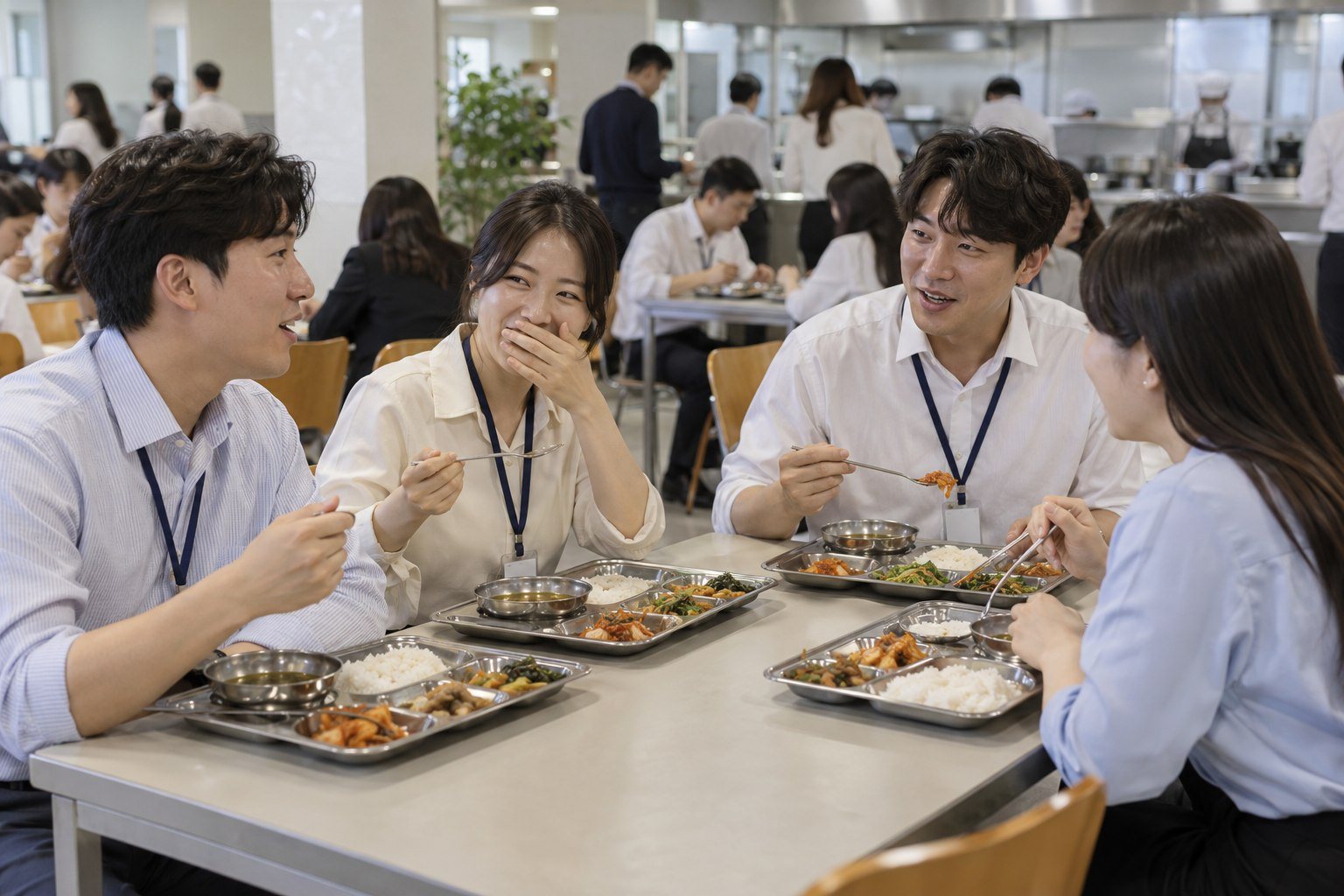
It’s 11:52 on your first Tuesday at a Korean company. Nobody has said the word “lunch”. Nobody has moved. But something has changed in the air. Monitors are dimming. Someone is quietly putting on a cardigan. The team leader stretches, glances at the clock, and says the most important sentence of the morning:
“밥 먹으러 갑시다.” (“Let’s go eat.”)
And suddenly eight people are standing up at once, like a flock of birds that got the same text. You grab your phone and follow. In the elevator lobby, three other teams have had exactly the same idea. The elevator arrives full. Then the next one. Welcome to Korean office lunch, which is part meal, part team ritual, part sprint, and part very polite chess game about who sits where and who pays.
The short version: in many Korean offices, especially traditional ones, the team eats lunch together, starts around noon on the dot and is back by 1. Follow the senior’s lead on where to go, sit wherever you’re pointed (away from the door is the honored seat), and if you’re junior, set out spoons, chopsticks and water without being asked. Ordering “the same” as everyone else is normal and saves time. The senior or the company card often pays; juniors often get the coffee. And yes, eating alone is now completely normal too: in a 2025 survey of 1,000 office workers, 47.7% said they sometimes eat lunch alone.
11:59 and the great migration
Korean office lunch is usually short and fixed. The Labor Standards Act requires employers to give at least an hour’s break during an eight-hour working day (30 minutes for four hours), and in practice most offices turn that into one hour, 12:00 to 1:00, for everyone at once.
Now picture an office district where thousands of people in lanyards leave their desks in the same five minutes:
- The elevator wave. Between 11:55 and 12:05, office elevators fill on the top floor and pass every other floor with a cruel little “ding” of full capacity. Some teams take the stairs down out of pure strategy.
- The 11:50 escape. Some teams leave ten minutes early to beat the queue. That’s the team leader’s call, not yours.
- The waiting line. Popular places have queues by 12:05, but the food arrives in minutes and the table is wiped before your chair is cold. This is 빨리빨리 in its natural habitat.
- The 12:55 walk-back. Everyone strolls back holding an iced Americano, regardless of season. Yes, even in January.
The 2025 Embrain Trend Monitor survey found that 59.3% of office workers think the roughly one-hour lunch is too short, and 64.2% want it longer for rest. So if you feel like lunch ended before it started, you’re in the majority.
“점심 뭐 먹지?”: the eternal question
Every Korean office has a daily philosophical crisis at about 11:40: “점심 뭐 먹지?” (“What should we eat for lunch?”). It is asked every single day, as if lunch were a brand-new invention.
In a traditional team, the answer usually comes from the top. The team leader says “오늘 국밥 어때?” (“How about gukbap today?”) and that is, technically, a question. In practice it’s a decision with a question mark on it. The polite answer is “좋습니다!” (“Sounds good!”).
If the team leader asks the juniors to choose, that’s both a kindness and a trap. “아무거나요” (“Anything’s fine”) is the most common answer in Korea and the least helpful one. Seniors genuinely appreciate a junior who has two or three nearby options ready: one soup, one noodle, one rice dish, all within a five-minute walk. Being the person who always knows a good place is a small but real office superpower.
What gets eaten? In a 2021 Embrain survey of 1,000 office workers, the top five lunches were jajangmyeon (44.5%), donkatsu (42.5%), baekban, the set meal of rice, soup and side dishes (39.4%), kimbap (39%) and burgers (36.2%).
Who sits where
You’ve arrived at the restaurant. Everyone hovers. Nobody sits. This is the seating dance, and it’s simpler than it looks.
The general rule in Korea is that the seat farthest from the door, often against the wall, is the honored seat (상석, sang-seok), and it goes to the most senior person. The seats nearest the door, the aisle or the kitchen, where you’ll be passing dishes and flagging down staff, go to the most junior. We cover this in more detail in Korean business etiquette.
At a casual team lunch it’s softer than at a client dinner. Just let the senior sit first, and if you’re junior, take the aisle seat, where the water and the calls to the staff happen.
If a senior says “아무 데나 앉아” (“Sit anywhere”), they mean it about 80%. The other 20% is the wall seat, which is theirs.
Spoons, chopsticks, water: the junior’s 30 seconds of glory
Here is the moment a new Korean employee’s reputation can be made. The second everyone sits down, someone reaches into the drawer under the table (or the metal box on top), lays out a paper napkin for each person, places a spoon and chopsticks on it, and pours water into everyone’s cup.
In a team, that someone is very often the most junior person. Nobody assigns the job. Nobody will ever say it’s your job. And nobody will ever forget whether you did it. This is nunchi at its purest: noticing what needs doing before anyone has to ask. (Our guide to Korean restaurant culture explains the drawer, the self-serve water and the table bell in full.)
A few fine points:
- Seniors first. Set the team leader’s place first, then work your way down. Same with the water.
- Grab the water bottle before it’s empty. At self-serve places, refilling the bottle from the water machine is also junior territory.
- If a senior beats you to it, a cheerful “앗, 감사합니다!” (“Oh, thank you!”) is fine. Next time, be a second faster.
“저도 같은 걸로요”: the art of ordering the same
Now the menu. In much of the West, a group lunch means everyone orders something different and maybe asks to try each other’s. In many Korean teams, something else happens.
The team leader says “난 김치찌개.” (“Kimchi stew for me.”) The next person says “저도요.” (“Me too.”) And then, like dominoes: “저도 같은 걸로요.” (“I’ll have the same, too.”) Within ten seconds, the whole table has ordered kimchi stew for eight. This is known as 메뉴 통일 (me-nyu tong-il), “menu unification”, and Korean office workers joke about it constantly.
Why does it happen?
- Speed. One dish for eight comes out faster than eight different dishes, and the restaurant loves you for it. At 12:10 in a packed restaurant with 50 minutes left, that matters.
- Harmony. Ordering the same is a tiny gesture of being part of the team (우리, “us”).
- Price. If someone senior is paying, quietly choosing something that costs the same or less is polite. Ordering the most expensive thing on the menu when the boss is paying is a classic rookie error that the whole table will notice and nobody will mention.
You don’t have to order the same. If you’re vegetarian, allergic, or just hate kimchi stew, order something else. A light “저는 이걸로 할게요” (“I’ll go with this one”) is perfectly fine. Just order quickly, ideally something in the same price range and with a similar cooking time. The real faux pas isn’t being different; it’s being slow.
Say / Mean: “저도 같은 걸로요” (jeo-do ga-teun geol-lo-yo), “Same for me, please.” What it says: I want the same dish. What it often means: I’m with the team, I’m not going to make this complicated, and I would like to eat before 12:30.
The meal itself: pace yourself to the slowest senior
Once the food arrives, the usual Korean table manners apply: wait for the senior to pick up their spoon first, don’t lift your rice bowl, use the spoon for rice and soup. Two things are special to the office version:
Speed is a team sport. Korean office workers are famously fast eaters. But the polite pace is the team’s pace, and the senior’s pace in particular. Finishing in eight minutes and staring at your phone while your team leader is halfway through their stew is not great. Neither is eating so slowly that the whole table is waiting for you at 12:45. Aim for the middle of the pack.
The conversation is light: weekend plans, a drama, the stock market. (There’s also the lunch where the team leader talks and everyone else nods and eats. If you’ve read our guide to 꼰대, you know the genre.)
When the senior puts down their spoon and says “갈까?” (“Shall we go?”), the meal is over. Everyone stands up. Nobody says “Wait, I’m just finishing my last dumpling.”
Who pays: the company card, the senior, or each person
This is where foreigners get most confused, because the answer depends on the company. There are four common setups:
- The company pays, one way or another. Many Korean companies give employees a meal allowance (식대, sik-dae). The tax system even encourages it: since 2023, up to ₩200,000 a month in meal allowance is tax-free, up from ₩100,000. It might arrive in your salary, as points on a corporate card, or through a mobile meal-voucher app (식권, sik-gwon) that you tap at partner restaurants.
- The company cafeteria. Bigger companies often run a 구내식당 (gu-nae-sik-dang), an in-house cafeteria. It’s cheap or free, fast, and the menu is posted every week. Sikshin, a mobile meal-voucher company, found that in Q2 2026 the average lunch payment at company cafeterias was ₩7,919, against ₩10,240 at regular restaurants nationwide and ₩11,586 in Seoul. “What’s on the cafeteria menu today?” is checked with the same seriousness as the weather.
- The senior pays. In more traditional teams, when the team leader takes the team out, the team leader (or the team budget, on the corporate card known as 법카) pays. When a senior colleague invites one junior to lunch, the senior very often pays. This is the old Korean logic of age and seniority: the older person treats, the younger person serves (see why Koreans ask your age).
- Everyone pays for themselves. 더치페이 (Dutch pay, as it’s called in Korean) is increasingly common, especially among colleagues of similar age and rank, and with apps that make splitting a bill a ten-second job.
If you’re junior and a senior pays: say “잘 먹겠습니다” (“I’ll eat well”, said before) and “잘 먹었습니다” (“I ate well”, said after, usually on the way out of the restaurant). Then do the thing every Korean office knows: offer to get the coffee.
The second round: coffee
Korean office lunch has a second act, and it’s served in a plastic cup with a lot of ice.
After eating, the team often walks to a café for 15 or 20 minutes. If the senior paid for lunch, a common unspoken pattern is that a junior offers to buy the coffee: “커피는 제가 살게요!” (“I’ll get the coffee!”). Lunch for eight at ₩10,000 a head versus Americanos for eight at a chain café is not exactly an even trade, and everyone knows that. The point is the gesture.
Other teams settle it with a game, like 사다리 타기 (sa-da-ri ta-gi), the “ladder game”, now usually played on an app. The losing intern gets sympathy and, often, a senior who quietly pays anyway.
And yes, it’s an iced Americano, so common it has its own nickname, 아아 (a-a), short for 아이스 아메리카노. Ordering one in January is completely normal.
The rise of the solo lunch (혼밥)
Here’s the biggest change in Korean office lunch over the past decade: plenty of people now eat alone, and it’s no longer strange.
혼밥 (hon-bap), short for 혼자 밥, “eating alone”, used to carry a whiff of sadness at work. Not eating with the team could look like you didn’t fit in. The numbers show how fast that’s changed:
- In a 2021 Embrain Trend Monitor survey of 1,000 office workers aged 19 to 59, 35.3% said they usually ate lunch alone, up from 31.8% the year before. Workers in their 20s were most likely to (40.8%), workers in their 50s least (28.8%). COVID-19 played a role: 61% said they were avoiding shared dishes like stews.
- In the 2025 follow-up survey (again 1,000 workers, multiple answers allowed), 47.7% said they eat alone at lunch, second only to eating with teammates (58.7%). Only 18.9% said eating alone felt uncomfortable.
- The pattern follows rank: 55.6% of staff-level employees said they ate alone, compared with 29.6% of department heads and above. The people with the least time to themselves all day are the most likely to want an hour of it.
Office workers also told that survey they eat lighter: 50.1% said they eat salads or sandwiches, and 54.1% said more coworkers are eating at the convenience store. And 59.2% said lunch helps them recover from work stress. In other words, for a lot of younger Korean workers, lunch has become a break first and a team event second. (It’s part of the same shift as 칼퇴, leaving on time, and the changes in the 회식.)
In practice, many offices now mix both. A team might eat together on Mondays or when there’s a newcomer, and leave the rest of the week free. People also make a 점심 약속 (jeom-sim yak-sok), a “lunch appointment”, with a friend from another team, a former colleague who works nearby, or a college friend whose office is two subway stops away. Saying “오늘 점심 약속 있어요” (“I have a lunch appointment today”) is a perfectly accepted way to skip the team lunch. Some people use it even when the “appointment” is with a gimbap and a quiet park bench. Nobody checks.
Your first week: what to actually do
In week one, assume the team eats together and follow along; many teams take a newcomer out early on. Watch, then match: by Friday you’ll know your team’s real rules on timing, paying and coffee.
When you want to eat alone, don’t disappear silently on the first days. A simple line works: “오늘은 혼자 간단히 먹을게요” (“I’ll grab something quick on my own today”). Said cheerfully, it’s not rude. In most offices in 2026, no one will blink.
Common mistakes:
- Sitting down first, in the wall seat, before the team leader.
- Letting the senior set out the spoons while you check your phone (if you’re junior).
- Ordering the most expensive dish when someone else is paying.
- Forgetting to say 잘 먹었습니다 to whoever paid.
- Ordering a hot latte with extra foam for eight when you offered to “get the coffee”. Iced Americanos. Trust the team.
Why does it all matter? In Korea, eating together is how people become “us” (there’s a reason Koreans greet each other with have you eaten?). The office lunch, with its spoons, its elevator wave and its eight bowls of kimchi stew, is where a team turns into people who know each other. Even if, three days a week, half of them would rather have a sandwich alone in the park.